News
GBS participates in discussion on energy security at the Sofia Economic Forum
Energy Minister Iva Petrova announced that construction works on the Vertical Gas Corridor had been completed several months ahead of schedule, while Kalin Peshov, Chairman of the Management Board of Glavbolgarstroy Holding, provided further details on the complexity and challenges of the project.
Energy security was among the leading topics at the Sofia Economic Forum, with discussions highlighting the role of nuclear energy, the stability of regional energy systems, infrastructure development, and the strategic importance of the Vertical Gas Corridor. Leading political figures, diplomats, representatives of international organisations and business leaders gathered for the seventh edition of the Sofia Economic Forum to discuss the key geopolitical and economic challenges facing Southeast Europe, with a particular focus on European unity, energy security and technological transformation.
The event was opened by Simeon Tsomokos, President of the Delphi Economic Forum, and Prime Minister Rumen Radev. In his special address to the participants, Radev emphasised the importance of strategic infrastructure and outlined the government's plans for developing the country's transport and energy infrastructure.
In the energy sector, the Prime Minister also identified several specific priorities, including expanding electricity storage capacity, implementing three pumped-storage hydropower projects, and enhancing the energy system's balancing capabilities. Deputy Prime Minister Atanas Pekanov also took part in the forum, stressing that EU Member States must significantly accelerate investment in emerging technologies, while businesses should be encouraged to make more active use of artificial intelligence.
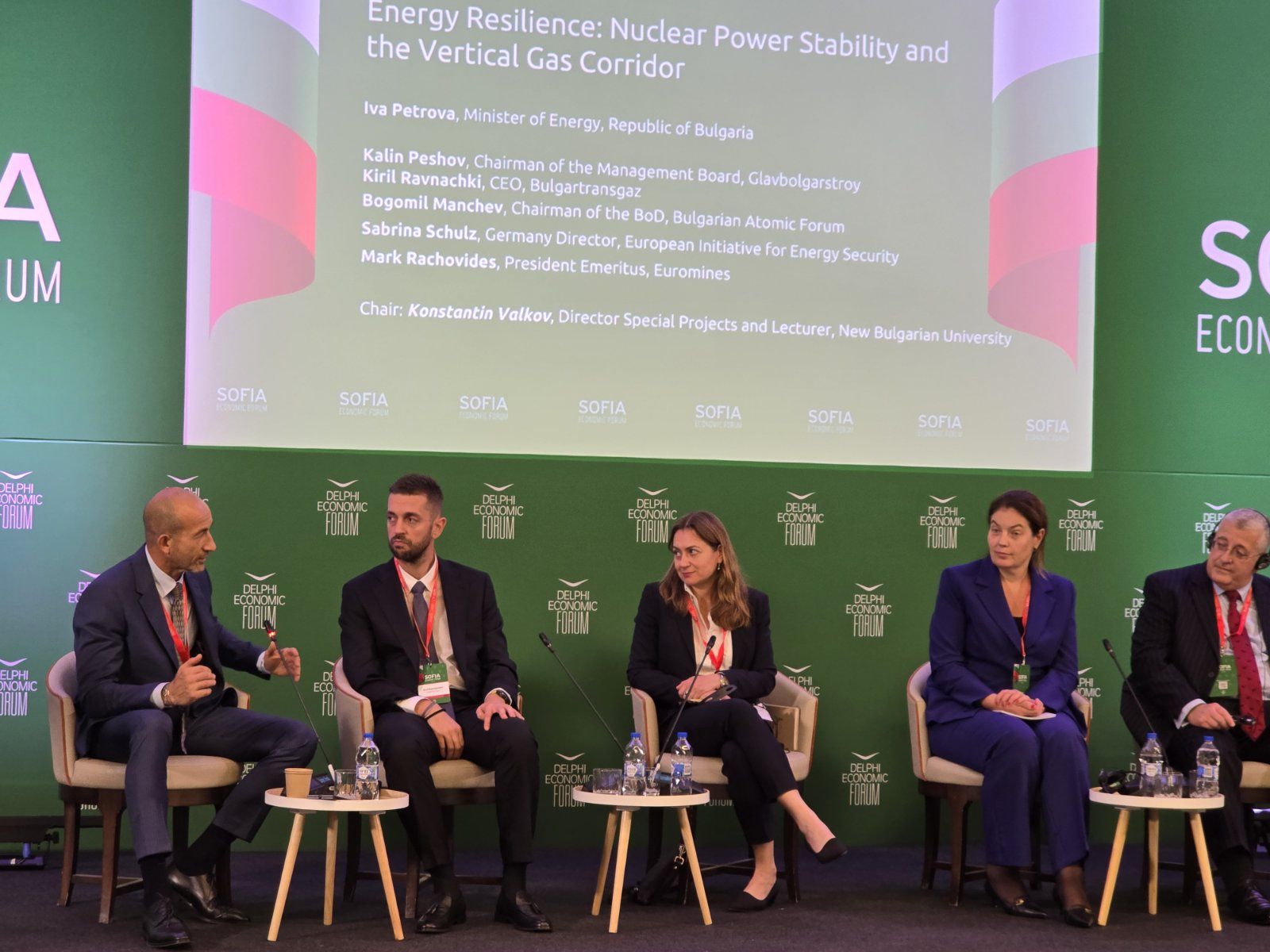
A panel discussion entitled "Energy Resilience: Stability of Nuclear Energy and the Vertical Gas Corridor" focused on security of supply and opportunities for diversification across Southeast Europe.
The discussion brought together Iva Petrova, Minister of Energy; Kiril Ravnashki, Executive Director of Bulgartransgaz; Bogomil Manchev, Chairman of the Bulgarian Atomic Forum; Sabrina Schulz, Director for Germany at the European Initiative for Energy Security; Mark Rachovides, Honorary President of Euromines; and Kalin Peshov, Chairman of the Management Board of Glavbolgarstroy Holding. The discussion addressed a range of key issues, including the development of a reliable energy network across Southeast Europe, the role of nuclear power in Bulgaria's energy mix, the need for closer regional integration and more secure supply chains, as well as the contribution of the Vertical Gas Corridor to diversifying energy sources and ensuring the country's energy stability.
Minister Petrova highlighted the construction of the Vertical Gas Corridor as a major infrastructure achievement and an example of regional solidarity amid geopolitical uncertainty. She announced that construction works had been completed ahead of schedule and commended the quality of the work carried out.
As the project's contractor, Kalin Peshov, Chairman of the Management Board of Glavbolgarstroy, provided insights into the challenges encountered during its implementation. He explained that geopolitical conflicts, supply chain disruptions and difficulties in maritime transport had created significant obstacles, potentially extending delivery times by approximately two months. The challenging terrain presented an additional difficulty, requiring more than 12 specialised drilling operations using advanced US equipment. Despite these challenges and potential delays, the facility is expected to be commissioned within the coming weeks.
International participants in the discussion also highlighted the conditions necessary to attract investment and advance the development of Europe's energy infrastructure. Mark Rachovides, Honorary President of the European mining organisation Euromines, warned that Europe must align its decarbonisation ambitions with concrete measures to secure access to raw materials, attract investment and ensure competitive energy costs. Sabrina Schulz, Director for Germany at the European Initiative for Energy Security, likewise emphasised the need for new financing mechanisms to encourage investment in strategic projects.
The panel also addressed the future implementation of one of Bulgaria's major strategic energy projects: the construction of Units 7 and 8 at the Kozloduy Nuclear Power Plant. The Minister of Energy stressed that preparing the transport infrastructure, logistics and workforce would be critical to the project's successful implementation.
Kalin Peshov also commented on the challenges involved in constructing the new nuclear units at Kozloduy, a project for which Glavbolgarstroy is involved in the preparatory work as a partner of South Korea's Hyundai and the US-based Westinghouse.
He noted that building a nuclear power plant is a complex, multi-stage process requiring comprehensive advance planning. This must cover not only the design and construction phases but also the supporting infrastructure needed for logistics and transport routes to deliver large quantities of construction materials and specialised equipment. Consequently, the infrastructure serving the plant must be considered as early as the design stage, while its implementation requires close coordination between public institutions and the private sector.
The discussion also touched upon the development of a small modular reactor (SMR) project through Bulgarian energy technology company Blue Bird Energy. Peshov explained that the company is pursuing an initiative in this field in its capacity as an investor, together with Asarel-Medet, and as a project developer, having selected GE Hitachi's technology.
Minister Petrova also expressed support for developing such a project in Bulgaria, noting that small modular reactors are among the technologies being considered by the Ministry of Energy as part of its long-term vision for the development of the energy sector.