News
Glavbolgarstroy (GBS) participates in the European Forum Alpbach
The Bulgarian construction holding company Glavbolgarstroy is participating in the 82nd edition of the European Forum Alpbach (EFA26), traditionally held in the Austrian mountain resort of the same name. This year’s edition brings together more than 4,000 participants from around the world to discuss key issues related to Europe’s geopolitical role and future amid a rapidly changing global order.
The conference programme was opened by the President of Austria, Alexander Van der Bellen. Official guests included King Philippe of Belgium, President of Germany Frank-Walter Steinmeier, and President of Switzerland Guy Parmelin.
In his address to delegates and guests, Van der Bellen called for closer cooperation and greater unity among European countries in the context of the changing geopolitical environment. According to him, Europe needs to become more independent of external factors, stressing the importance of strengthening energy supplies and diversifying sources of supply, alongside enhancing European defence capabilities and critical infrastructure. “The challenges Europe is facing can only be overcome when we stand together,” the Austrian president concluded in Alpbach.
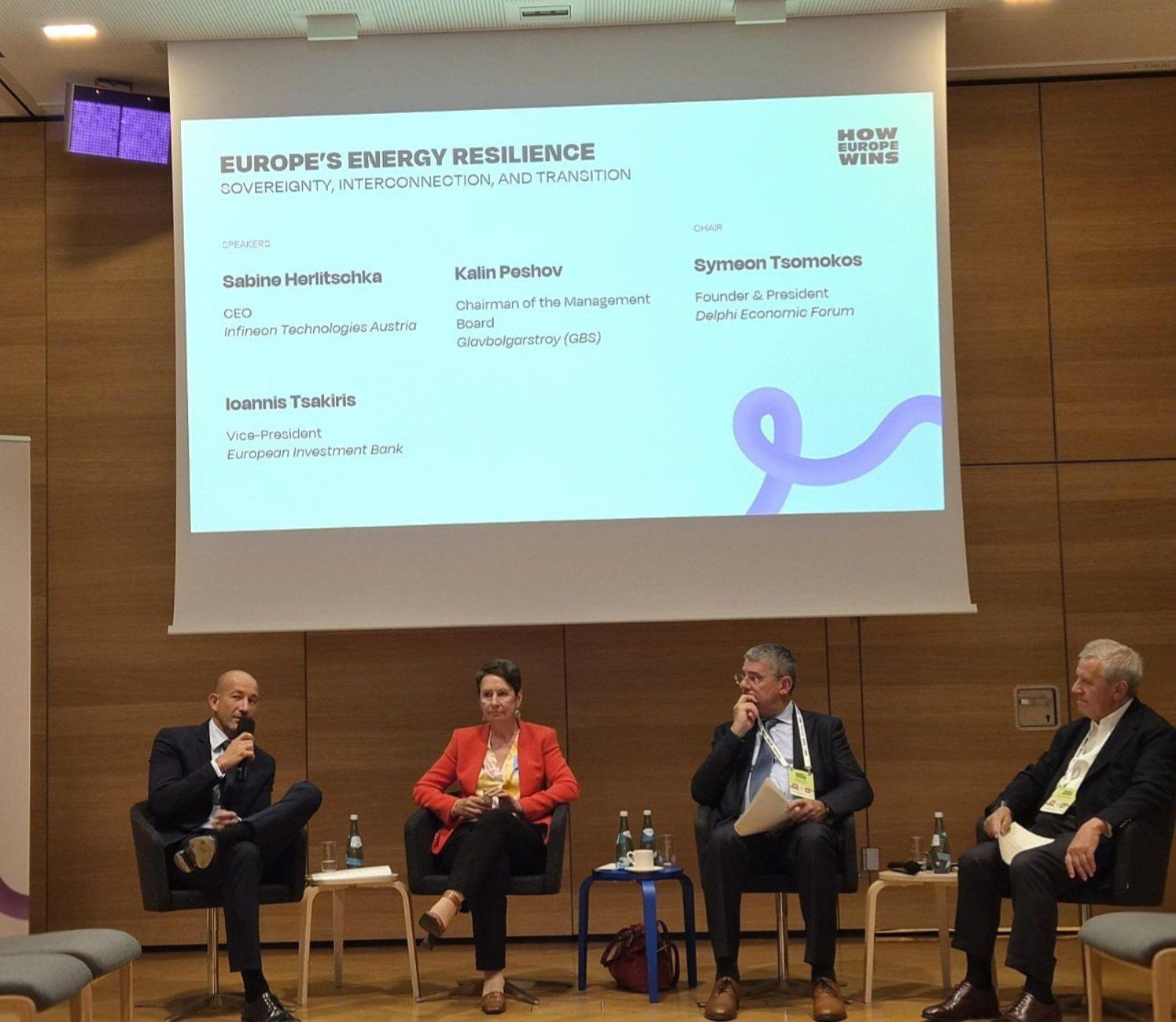
As part of a discussion dedicated to energy sovereignty, cross-border connectivity and Europe’s energy transition, Kalin Peshov, Chairman of the Management Board of Glavbolgarstroy, took part in the panel. Key topics included the development of critical infrastructure and the need for closer regional cooperation in Southeast Europe. The participants also discussed the challenges facing the region in ensuring access to affordable and secure energy against the backdrop of a rapidly changing geopolitical context.
In this regard, Kalin Peshov stressed that the energy transition requires not only an increase in generation capacity, but also the timely development of the infrastructure needed to support it. According to him, the development of new energy generation capacity and the construction of the necessary infrastructure must progress in parallel in order to ensure system reliability and the ability to meet future demand. He also highlighted the importance of regional connectivity as a key factor in making more efficient use of energy resources, as well as the need for the rapid implementation of major strategic projects in Southeast Europe, such as the Vertical Gas Corridor. The project is currently being fast-tracked on Bulgarian territory, with Glavbolgarstroy fully committed to completing the construction works within the next few weeks.
Peshov identified the development of nuclear energy as a reliable resource, both through conventional large-capacity reactors and through the deployment of small modular reactor (SMR) technology. He stressed that Bulgaria is actively working towards the implementation of such projects in the country.
During the debate, together with European Investment Bank (EIB) Vice-President Ioannis Tsakiris, the participants discussed the role of public-private partnerships in attracting investment and delivering infrastructure projects. According to Tsakiris, alongside public funding, Greece is increasingly making successful use of mechanisms for attracting private capital to projects in the energy and transport infrastructure sectors.
In this context, the Chairman of the Management Board of Glavbolgarstroy stressed that the private sector plays a leading role in delivering complex infrastructure projects, while public-private partnerships can contribute to the faster implementation of strategic initiatives. Peshov noted that he was also encouraged by the direction taken by the Bulgarian Government, whose programme places particular emphasis on the implementation of key connectivity projects through this model.
Among the other participants in the discussion was Sabine Herlitschka, CEO of Infineon Technologies, one of Austria’s largest semiconductor manufacturers. She focused on the cybersecurity challenges facing critical energy and technological infrastructure against the backdrop of increasing digitalisation and the growing interconnectivity of power systems.
According to Leonhard Schitter, CEO of Austrian energy provider Energie AG Oberösterreich, access to reliable energy sources is a strategic factor in ensuring Europe’s security. In his view, Europe needs to accelerate its key infrastructure projects, European countries need to cooperate more closely, and the continent needs to become more self-reliant in its actions.